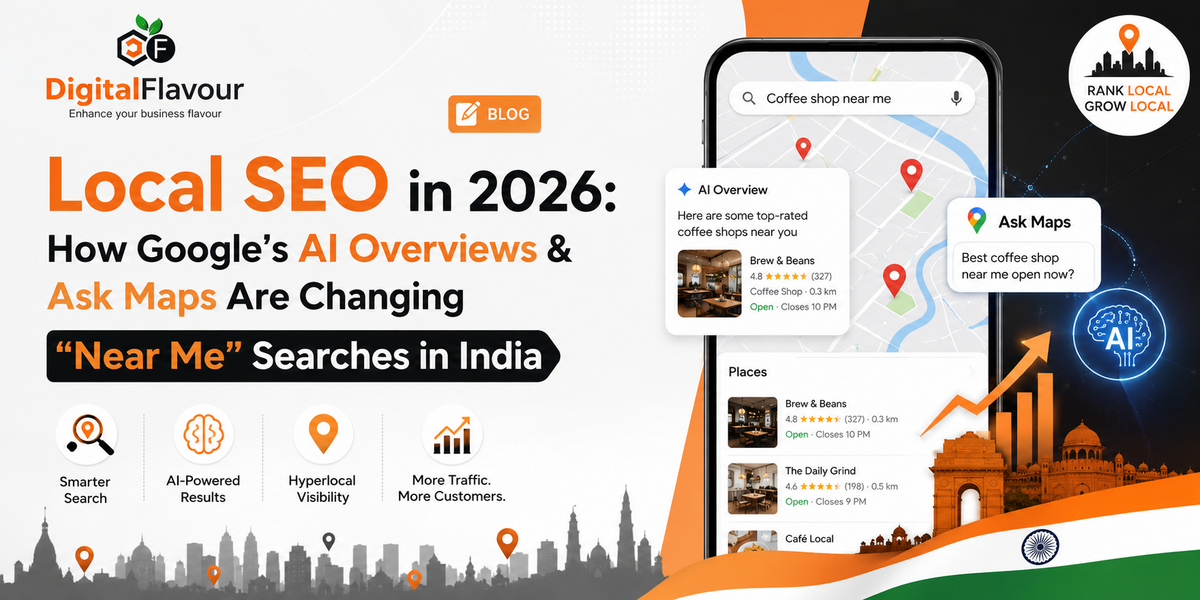
Google now uses AI – through AI Overviews and a new feature called Ask Maps – to recommend local businesses directly inside search and Maps. For Indian businesses, this means your Google Business Profile, reviews, and website content are no longer just ranking factors. They’re now the raw material AI reads to decide whether to recommend you at all.
If you’ve noticed your “near me” traffic behaving differently this year, you’re not imagining it. Search in India changed in March 2026. Here’s exactly what happened, and what to do about it.
Want to Rank Your Business on Local Searches, Consult Digital Flavour, result oriented Digital Marketing Agency.
What Changed: AI Overviews and Ask Maps, Explained Simply
For years, local SEO had one main goal: rank in Google’s “Local Pack,” the three map listings that show up when someone searches “plumber near me” or “best bakery in my area.”
That’s no longer the only game.
AI Overviews are AI-generated summaries that now appear above those traditional results. Instead of showing ten blue links, Google often answers the question directly, recommending specific businesses by name.
Ask Maps is newer, and it’s a bigger shift. On March 12, 2026, Google announced Ask Maps, a conversational AI layer built into Google Maps using Gemini models. It rolled out in the US and India together, on Android and iOS.
Here’s what makes Ask Maps different from a normal Maps search:
- You can ask it complex, natural questions, not just keywords. Example: “My parents are visiting Mumbai this weekend, what can they easily cover?”
- It pulls from over 300 million places and reviews from more than 500 million contributors worldwide to build its answer.
- It doesn’t just list businesses. It explains why it’s recommending them — things like ambience, parking, or what reviewers mention most.
- Once it recommends a place, users can book, save, or navigate without leaving the conversation.
| Why this matters for your business ? Ask Maps and AI Overviews don’t read your website the way a human visitor does. They read your entity — your name, address, category, reviews, and online mentions, all pieced together. If that picture is incomplete or inconsistent, AI has nothing solid to recommend. |
Why This Shift Hits Indian Businesses Differently
Local search in India was never going to evolve the same way it did in the US or UK. A few things make this AI shift even more important here.
India searches on mobile, by default, not by preference.
The overwhelming majority of Indian internet users are mobile-first. When Ask Maps rolled out, it launched on Android and iOS first, before desktop. That’s not a coincidence — it’s where Indian search behaviour already lives.
“Near me” in India often isn’t typed in English.
Voice search and Hinglish queries are mainstream now, not an edge case. Someone might type “best dentist near me” or ask out loud, “mere paas accha dentist kaun hai.” If your business information only exists in clean English on your website, you’re invisible to a meaningful share of local searches.
India already has its own local trust ecosystem.
Platforms like JustDial, Sulekha, and IndiaMART carry real weight with Google’s Indian index, on top of Google Business Profile itself. AI tools pull signals from this wider footprint, not just your website.
Tier 2 and Tier 3 cities have the most to gain.
In metros like Mumbai, Delhi, or Bengaluru, competition is fierce no matter what. But in smaller cities, AI Overviews and Ask Maps are often working with thinner data. A business that builds a clear, consistent online presence can get recommended ahead of bigger competitors simply because no one else has done the basics properly yet.
How Google’s AI Actually Decides Who to Recommend
This is the part most business owners skip, and it’s the part that actually determines whether you show up.
AI Overviews and Ask Maps don’t run on a separate ranking system. They build on the same local signals Google has always used, then layer AI interpretation on top. According to Whitespark’s 2026 Local Search Ranking Factors survey, here’s roughly how the weight breaks down:
| Ranking Signal | Approx. Weight | Can You Control It? |
| Proximity to the searcher | ~55% | No |
| Google Business Profile signals | ~32% | Yes |
| Review signals (volume, recency, sentiment) | 16–20% | Yes |
| On-page local SEO (schema, content) | ~19% | Yes |
| Citation consistency (NAP across directories) | ~11% | Yes |
| Behavioural signals (calls, clicks) | ~8% | Partially |
| Local backlink quality | ~7% | Yes |
You can’t control proximity. Everything else on that list, you can.
Three signals matter more for AI visibility specifically than they used to for plain rankings:
- FAQ-formatted content. Google’s AI Overviews are increasingly built from FAQ-style Q&A content, including the Q&A section on your Google Business Profile itself.
- Review depth, not just star rating. AI tools read what reviews actually say. A review that mentions your service and location by name (“great teeth cleaning in Indiranagar”) carries more signal than a five-star rating with no detail.
- Consistency everywhere your business is mentioned. If your business name, address, or phone number differs even slightly between your website, GBP, and a directory listing, AI has a harder time confirming it’s the same business.
Your Local SEO Checklist for the AI Search Era
Here’s what to actually do, in order of impact.
1. Fix and complete your Google Business Profile
Claim it if you haven’t. Choose the most specific category available — not “Restaurant” but “South Indian Restaurant.” Fill in every field: hours, services, products, attributes, and a complete business description.
2. Write your GBP Q&A section yourself
Don’t leave this to strangers. Add your 10 most common customer questions and answer them directly, in plain language, with your city and service named naturally. This section is frequently pulled directly into AI Overviews.
3. Get reviews that say something specific
Ask happy customers right after the service, while it’s fresh. A simple WhatsApp message with your review link works well in India. Gently encourage detail: what service, what location, what they liked.
4. Make your NAP identical everywhere
Your business Name, Address, and Phone number should match, character for character, across your website, GBP, and every directory listing (JustDial, Sulekha, IndiaMART, and others relevant to your industry).
5. Add structured data to your website
LocalBusiness schema and FAQ schema help both traditional Google rankings and AI systems understand exactly who you are and what you answer. This is technical work, and it’s worth getting right.
6. Write content the way people actually ask questions
Structure your FAQs and service page headings as real questions: “How much does SEO cost for a small business in Pune?” not just “Pricing.” This format is what both voice search and AI Overviews are built to extract.
7. Stay active on your profile, weekly
Photos, posts, and prompt replies to messages all signal that your business is real, current, and engaged. AI systems weigh activity, not just static information.
What This Actually Means for Your Business
None of this requires throwing out your existing SEO work. AI Overviews and Ask Maps build on the same foundation: a complete profile, real reviews, consistent information, and content that answers real questions clearly.
What’s changed is the cost of getting it wrong. A business with a thin, inconsistent online presence used to rank lower. Now, it risks being skipped entirely — even by a customer standing right outside its door — because the AI assistant they asked couldn’t confidently confirm who they were.
The businesses already ahead in 2026 aren’t doing anything exotic. They’re doing the fundamentals properly, then making sure that information is structured clearly enough for AI to read it.
Frequently Asked Questions
What is Ask Maps and is it available in India?
Ask Maps is a Gemini-powered conversational feature inside Google Maps. Google announced it on March 12, 2026, and it rolled out in India and the US together, on Android and iOS, in English first.
How is Ask Maps different from a normal Google Maps search?
A normal search returns a list of places matching your keywords. Ask Maps understands full, natural questions, such as “where can I take my parents this weekend,” and gives a personalised answer with reasoning, drawing on reviews and place data, not just a list.
Do I need a website if I already have a Google Business Profile?
Having a website significantly strengthens your authority and gives AI systems more structured information to draw from, especially through schema markup and FAQ content. A GBP alone is a strong start, but it has limits on its own.
How do I get my business to show up in Google’s AI Overviews?
Focus on a complete, accurate Google Business Profile, genuine reviews that mention specific services and locations, consistent business information across the web, and FAQ-style content on your website that directly answers common customer questions.
Does voice search in Hindi or Hinglish affect my local SEO in India?
Yes. A large share of Indian searches are now voice-based, and many mix Hindi and English naturally. Writing your FAQs and GBP description the way customers actually speak, not just formal English, helps you appear in these searches.
How long does it take to see results from local SEO in 2026?
Google Business Profile improvements can show results within a few weeks. Broader local SEO gains, rankings, and AI citation typically take two to four months, depending on your city’s competition level.
Want help making sure your business shows up when customers ask Google, ChatGPT, or Maps for a recommendation? Digital Flavour helps Indian businesses build the kind of local SEO foundation that AI search is actually built to find — from Google Business Profile optimization to review strategy to AI-ready content.